
What Are Hunter Eyes? Meaning, Features & Free Test
Discover what hunter eyes are, their key features, positive canthal tilt, and how they compare to prey eyes. Try a free Hunter Eyes test online.
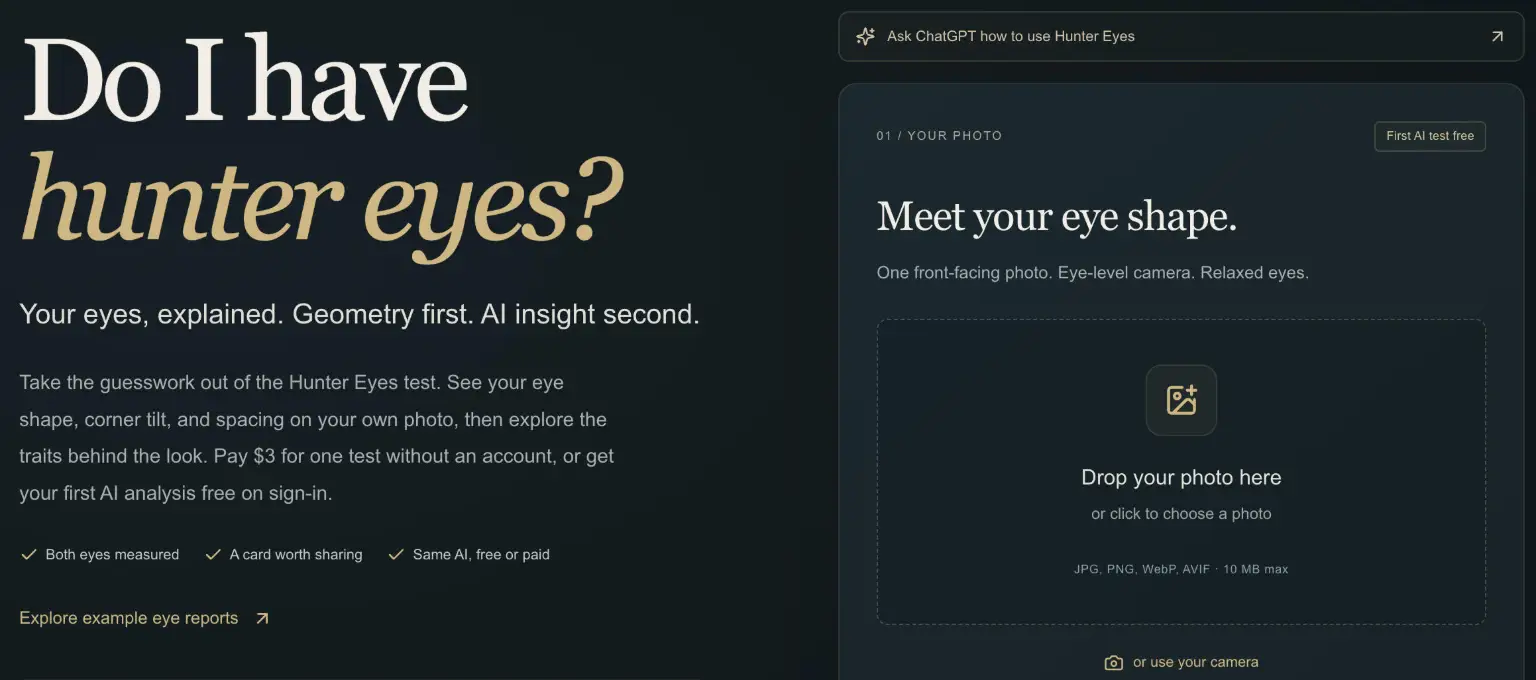
Table of Contents
Discover Your Hunter Eyes Score
Curious whether you have hunter eyes? Want to understand your eye shape, canthal tilt, and overall eye proportions?
Try the Hunter Eyes Test — an AI-powered eye shape analysis tool that helps you explore the features associated with hunter eyes using your own photo.
- Analyze Your Eye Shape: Explore your eye shape and proportions.
- Measure Canthal Tilt: See the angle of your inner and outer eye corners.
- Explore Eye Features: Get AI insights into your eyelids, lower eyelids, and brow area.
- Get a Shareable Result: Create a personalized result card to share.
Simply upload a clear, front-facing photo and explore your eye characteristics.
Try the Free Hunter Eyes Test →
Your results are for personal exploration and entertainment, not a medical assessment or scientific attractiveness rating.
What Are Hunter Eyes?
Hunter eyes are a popular facial aesthetics term used to describe a particular eye shape characterized by a narrow, elongated appearance, a relatively deep-set look, and often upward-tilting outer eye corners.
The term became especially popular in online looksmaxxing communities, where people discuss facial features, proportions, and ways to improve their appearance.
Hunter eyes are commonly associated with an intense, focused, and confident-looking expression. Many people consider this eye shape aesthetically appealing because of its combination of sharp contours and relatively compact eyelid exposure.
However, hunter eyes are not an official medical or anatomical classification. They are an informal description of several individual eye-area characteristics.
Understanding these characteristics is more useful than simply trying to determine whether someone has hunter eyes or prey eyes.
5 Key Features of Hunter Eyes
Hunter eyes are generally associated with several characteristics. Not everyone needs to have all of them to fit the common description.
1. Positive Canthal Tilt
Canthal tilt refers to the angle formed by the inner and outer corners of the eye.
A positive canthal tilt means the outer corner sits higher than the inner corner. This creates a slightly upward-sloping appearance.
It is one of the most frequently discussed characteristics of hunter eyes.
A more neutral or downward-sloping angle can create a different overall impression. However, there is no universally accepted ideal angle, and a positive tilt alone does not determine someone's eye shape or attractiveness.
2. Almond-Shaped Eyes
Hunter eyes are often described as almond-shaped, with a relatively elongated horizontal opening and less vertical exposure.
Compared with rounder eyes, almond-shaped eyes can create a narrower and more defined appearance.
The actual shape varies naturally between individuals, and eye shape is influenced by eyelid anatomy, surrounding soft tissue, and genetics.
3. Low Upper Eyelid Exposure
Another commonly mentioned feature is limited visible upper eyelid space.
When less skin is visible between the upper eyelashes and the eyelid crease, the eyes may appear more compact or slightly hooded.
This can contribute to the characteristic intense look often associated with hunter eyes.
However, upper eyelid exposure varies significantly between people and should not be treated as a universal beauty standard.
4. Low Lower Scleral Show
Scleral show refers to the visible white part of the eye around the iris.
Hunter eyes are commonly associated with little or no visible white beneath the iris when looking straight ahead.
This can make the eye opening appear more compact and horizontally elongated.
Eye position, facial expression, gaze direction, and lower eyelid anatomy can all influence how much sclera is visible.
5. Deep-Set Eyes and Brow Structure
Deep-set eyes appear to sit farther back within the eye socket, often creating natural shadows around the upper eyelids.
A prominent brow ridge can contribute to this appearance by framing the eyes and making the upper eye area look more defined.
This combination is frequently associated with the sharp, focused appearance described in hunter eyes discussions.
It is important to remember that a regular front-facing photograph cannot accurately measure the actual depth of someone's eye sockets.
Hunter Eyes vs. Prey Eyes: What's the Difference?
One of the most popular discussions in looksmaxxing communities is the comparison between hunter eyes and prey eyes.
These terms describe two contrasting eye-area appearances.
| Feature | Hunter Eyes | Prey Eyes |
|---|---|---|
| Eye shape | Narrow, elongated | Rounder, wider |
| Canthal tilt | Often positive | Often neutral or negative |
| Upper eyelid | Less visible | More visible |
| Lower scleral show | Usually limited | May be more noticeable |
| Overall impression | Intense and defined | Open and expressive |
The distinction is mainly based on visual characteristics rather than medical definitions.
Neither eye shape is inherently better than the other. Facial attractiveness depends on many factors, including overall facial harmony, individual preferences, and cultural influences.
Some people also have a combination of features that do not fit neatly into either category.
What Determines Whether You Have Hunter Eyes?
Your eye appearance is influenced by several anatomical and environmental factors.
Genetics and facial anatomy
Genetics play an important role in determining eye shape, eyelid structure, brow position, and the surrounding facial bone structure.
These characteristics are largely established during development and naturally vary between individuals.
Eyelid structure
The position of the upper and lower eyelids influences how much of the eye is visible. Differences in eyelid folds and surrounding soft tissue can significantly change the overall appearance.
Brow position and orbital structure
The brow ridge and surrounding bone structure contribute to how deep-set or prominent the eyes appear.
Facial expression
Squinting, raising the eyebrows, smiling, or relaxing the face can change the visible eye opening. Even small expression differences can make the same person's eyes look quite different.
Photography and lighting
Camera angle, distance, lighting, and head position can dramatically affect how eye features appear in photographs.
For example, a downward head angle may make the upper eyelid appear less visible and change the apparent canthal tilt.
This is why standardized photographs are important when comparing eye shapes.
How to Test If You Have Hunter Eyes
If you have ever wondered, "Do I have hunter eyes?", examining your eye characteristics can be a useful starting point.
Instead of relying entirely on visual guesses, you can use an eye analysis tool to explore individual measurements and features.
Try the Hunter Eyes Test Online
HunterEyes.net provides an AI-powered way to explore your eye shape using a photograph.
The process is simple:
Step 1: Upload a Photo
Choose a clear, front-facing photograph where both eyes are visible. Avoid heavy filters, glasses, and strong shadows.
Step 2: Analyze Your Eye Geometry
The tool traces your eye outlines and calculates several measurements, including eye width-to-height ratios, canthal tilt, and eye spacing.
Step 3: Explore Your AI Analysis
Get additional observations about visible eyelid characteristics, lower eyelid shape, and brow framing.
Step 4: View and Share Your Results
Explore your personalized report and create a shareable result card.
You can also explore different eye characteristics without treating a single label as the final answer.
Take the Hunter Eyes Test at HunterEyes.net →
Can You Get Hunter Eyes Naturally?
This is another frequently asked question in the looksmaxxing community.
The answer depends on which characteristics you want to change.
Some aspects of eye appearance can be influenced by everyday habits and styling choices, while others are largely determined by anatomy.
What You Can Change
- Eyebrow grooming: Adjusting eyebrow shape can change how your eyes are framed.
- Sleep quality: Getting sufficient sleep may help reduce temporary puffiness and tired-looking eyes.
- Skincare: Appropriate skincare can improve the appearance of the skin around your eyes.
- Makeup and styling: Eyeliner and other styling techniques can create the appearance of more elongated or lifted eyes.
- Photography: Better lighting, camera positioning, and facial expression can make your natural eye features more visible.
What Is Difficult to Change
Structural characteristics such as orbital bone shape, natural eye depth, and eyelid attachment positions are largely determined by anatomy.
There is currently no reliable scientific evidence that exercises such as squint training or mewing can reshape an adult's eye sockets or permanently create hunter eyes.
Cosmetic procedures involving the eyelids or outer eye corners exist, but they involve medical risks and should only be discussed with qualified medical professionals.
It is not necessary to change your natural eye shape to improve your appearance.
Are Hunter Eyes Scientifically Proven to Be More Attractive?
Hunter eyes are often presented online as an ideal eye shape, especially in looksmaxxing discussions.
However, there is an important distinction between individual facial features and the broader hunter eyes label.
Some research has explored how eye-corner angles, eyelid exposure, and other facial characteristics influence attractiveness judgments in particular groups of photographs.
These studies do not establish that hunter eyes are universally more attractive.
Facial attractiveness is subjective and depends on the interaction between different features. Eye shape is only one part of overall facial appearance.
A person's overall facial harmony, eyebrows, cheekbones, jawline, skin quality, and expression can all influence how their eyes are perceived.
Rather than focusing on achieving one specific eye shape, it is more useful to understand your natural features and find ways to present them confidently.
Frequently Asked Questions About Hunter Eyes
What are hunter eyes?
Hunter eyes are an informal facial aesthetics term describing a narrow, often almond-shaped eye appearance, typically associated with positive canthal tilt, limited upper eyelid exposure, and a deep-set look.
How do I know if I have hunter eyes?
You can start by examining your eye shape, canthal tilt, eyelid exposure, and surrounding brow structure. An online tool such as HunterEyes.net can help you explore these characteristics using a photograph.
Are hunter eyes genetic?
Many of the structural characteristics associated with hunter eyes, including eye shape, eyelid anatomy, and orbital structure, are strongly influenced by genetics.
Are hunter eyes and almond eyes the same?
No. Almond-shaped eyes describe an eye shape, while hunter eyes refer to a broader combination of characteristics. Someone can have almond-shaped eyes without having all the features commonly associated with hunter eyes.
Can women have hunter eyes?
Yes. Hunter eyes is an informal appearance term that can describe eye characteristics in both men and women. There is no separate medically defined version for either sex.
Is positive canthal tilt necessary for hunter eyes?
Positive canthal tilt is one of the most commonly mentioned features, but there is no universally accepted definition or measurement threshold for hunter eyes.
Can AI detect hunter eyes?
AI tools can analyze visible characteristics in photographs, such as eye proportions and eyelid appearance. However, image-based analysis has limitations, especially when evaluating three-dimensional structures such as actual orbital depth.
Final Thoughts
Hunter eyes have become a popular topic in facial aesthetics, particularly among people interested in looksmaxxing and understanding facial proportions.
The concept combines several characteristics, including positive canthal tilt, almond-shaped eyes, limited eyelid exposure, and a deep-set appearance.
While these features can influence how the eye area looks, there is no single eye shape that defines attractiveness.
If you are curious about your own eye characteristics, try the Hunter Eyes Test to explore your eye geometry and get a better understanding of your natural features.
Discover your eye shape, understand your proportions, and explore what makes your eyes unique.